http://www.mrlincolnandfreedom.org/map/1863.html
Click on the dates in the timeline to see the changing face of slavery in this period.
Wednesday, September 1, 2010

Monday, August 2, 2010
The Organic Laws of the United States
The Declaration of Independence
http://www.usconstitution.net/gifs/docs/declar.jpg
The Articles of Confederation
http://www.usconstitution.net/gifs/docs/articles1.jpg
The Northwest Ordinance
http://www.ourdocuments.gov/doc_large_image.php?flash=true&doc=8
http://upload.wikimedia.org/wikipedia/commons/9/9e/Northwest-territory-usa-1787.png
The Constitution for the United States
http://upload.wikimedia.org/wikipedia/commons/1/19/Constitution_Pg1of4_AC.jpg
The organic laws of the United States of America are included in the U.S. Code. These documents include the United States Declaration of Independence, the Articles of Confederation, the Northwest Ordinance, and the U.S. Constitution. These documents comprise the very first part of the United States Code, wherein lies the collected statutes of the United States of America.
Both the Declaration of Independence and the U.S. Constitution are looked upon, by most citizens of the United States, as the "legal bible" of the United States. Lincoln maintained that the Declaration was "the first of the laws of the United States and...the controlling legal authority as to the meaning of the principles of the Constitution." (Jaffa, CRB, [Winter 2005/06, p.38]).
Echoing a similar sentiment, perhaps referencing St. Paul's wisdom that "the letter killeth, but the spirit giveth life," Cristopher Levenick states that "the letter of the Constitution is incomplete without being animated by the spirit of the Declaration." (Levenik, CRB, [Winter 2005/06, p. 40]).
http://www.usconstitution.net/gifs/docs/declar.jpg

The Articles of Confederation
http://www.usconstitution.net/gifs/docs/articles1.jpg

The Northwest Ordinance
http://www.ourdocuments.gov/doc_large_image.php?flash=true&doc=8
http://upload.wikimedia.org/wikipedia/commons/9/9e/Northwest-territory-usa-1787.png
The Constitution for the United States
http://upload.wikimedia.org/wikipedia/commons/1/19/Constitution_Pg1of4_AC.jpg

The organic laws of the United States of America are included in the U.S. Code. These documents include the United States Declaration of Independence, the Articles of Confederation, the Northwest Ordinance, and the U.S. Constitution. These documents comprise the very first part of the United States Code, wherein lies the collected statutes of the United States of America.
Both the Declaration of Independence and the U.S. Constitution are looked upon, by most citizens of the United States, as the "legal bible" of the United States. Lincoln maintained that the Declaration was "the first of the laws of the United States and...the controlling legal authority as to the meaning of the principles of the Constitution." (Jaffa, CRB, [Winter 2005/06, p.38]).
Echoing a similar sentiment, perhaps referencing St. Paul's wisdom that "the letter killeth, but the spirit giveth life," Cristopher Levenick states that "the letter of the Constitution is incomplete without being animated by the spirit of the Declaration." (Levenik, CRB, [Winter 2005/06, p. 40]).
Friday, July 30, 2010
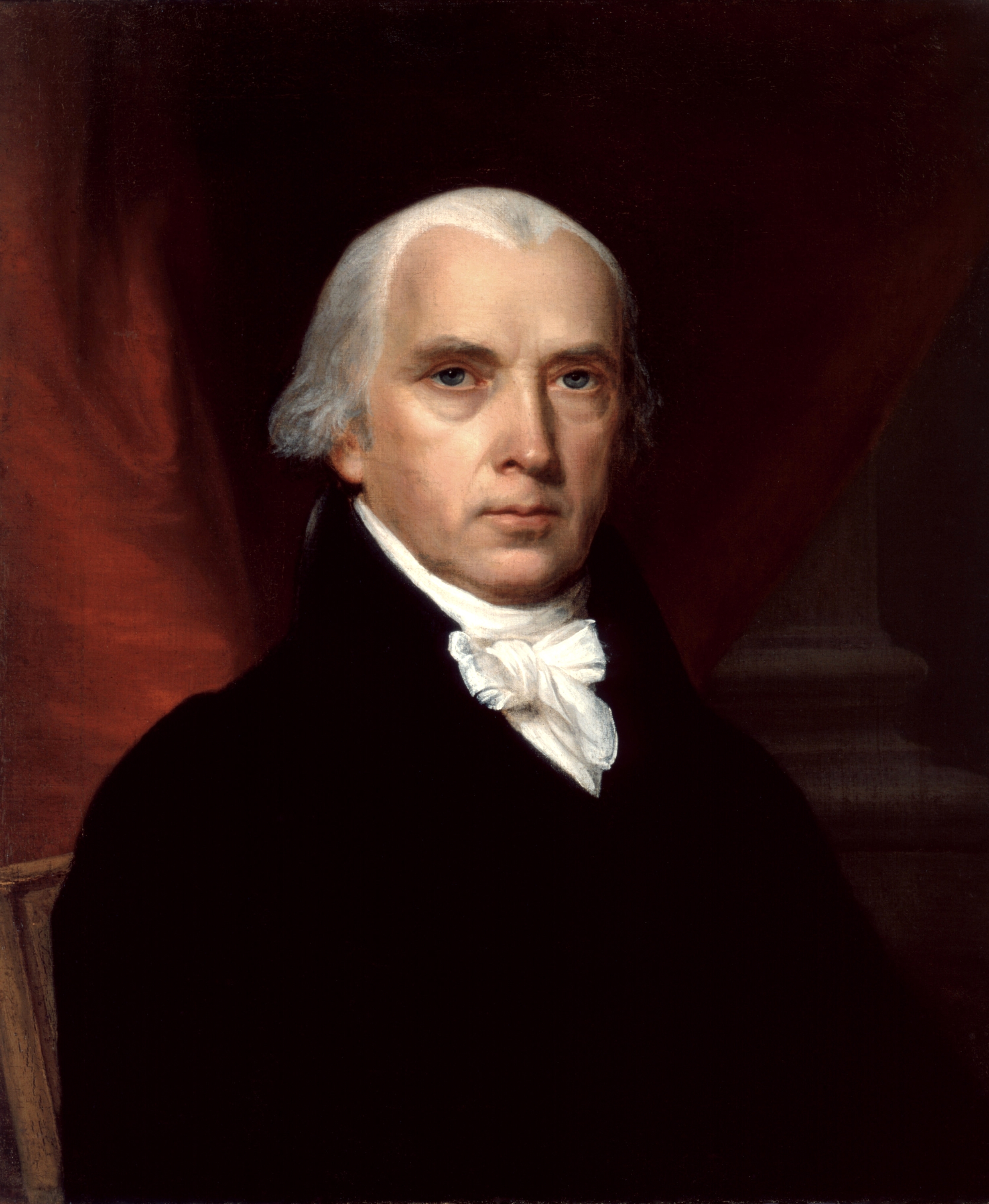
James Madison
http://upload.wikimedia.org/wikipedia/commons/1/1d/James_Madison.jpg
"We hold it for a fundamental and undeniable truth, that religion, or the duty we owe our Creator and the manner of discharging it, can be directed only by reason and conviction, not by force or violence. The religion then of every man must be left to the conviction and conscience of every man; and it is the right of every man to exercise it as these may dictate. This right is in its nature an unalienable right"
"We hold it for a fundamental and undeniable truth, that religion, or the duty we owe our Creator and the manner of discharging it, can be directed only by reason and conviction, not by force or violence. The religion then of every man must be left to the conviction and conscience of every man; and it is the right of every man to exercise it as these may dictate. This right is in its nature an unalienable right"
Alexander Hamilton
http://upload.wikimedia.org/wikipedia/en/e/ec/Hamiltontrumbull-crop.jpg
If the federal government should overpass the just bounds of its authority and make a tyrannical use of its powers, the people, whose creature it is, must appeal to the standard they have formed, and take such measures to redress the injury done to the Constitution as the exigency may suggest and prudence justify.
Alexander Hamilton, Federalist No. 33, January 3, 1788

If the federal government should overpass the just bounds of its authority and make a tyrannical use of its powers, the people, whose creature it is, must appeal to the standard they have formed, and take such measures to redress the injury done to the Constitution as the exigency may suggest and prudence justify.
Alexander Hamilton, Federalist No. 33, January 3, 1788
Thomas Jefferson
http://upload.wikimedia.org/wikipedia/commons/b/bc/ThomasJeffersonStateRoomPortrait.jpg
The God who gave us life, gave us liberty at the same time; the hand of force may destroy, but cannot disjoin them.

The God who gave us life, gave us liberty at the same time; the hand of force may destroy, but cannot disjoin them.
Washington at Valley Forge
http://www.fribergfineart.com/Images/PVF%20front%20page%20image.jpg
The nearest to an authentication of the Potts story of Washington's prayer in the woods seems to be supplied by the "Diary and Remembrances" of the Rev. Nathaniel Randolph Snowden, an ordained Presbyterian minister, graduate of Princeton with a degree from Dickinson College. The original is owned by the Historical Society of Pennsylvania. Mr. Snowden was born in Philadelphia January 17, 1770 and died November 12, 1851. His writings cover a period from youth to 1846. In his records may be found these observations, in Mr. Snowden's own handwriting:
"I knew personally the celebrated Quaker Potts who saw Gen'l Washington alone in the woods at prayer. I got it from himself, myself. Weems mentioned it in his history of Washington, but I got it from the man myself, as follows:
"I was riding with him (Mr. Potts) in Montgomery County, Penn'a near to the Valley Forge, where the army lay during the war of ye Revolution. Mr. Potts was a Senator in our State & a Whig. I told him I was agreeably surprised to find him a friend to his country as the Quakers were mostly Tories. He said, 'It was so and I was a rank Tory once, for I never believed that America c'd proceed against Great Britain whose fleets and armies covered the land and ocean, but something very extraordinary converted me to the Good Faith!" "What was that," I inquired? 'Do you see that woods, & that plain. It was about a quarter of a mile off from the place we were riding, as it happened.' 'There,' said he, 'laid the army of Washington. It was a most distressing time of ye war, and all were for giving up the Ship but that great and good man. In that woods pointing to a close in view, I heard a plaintive sound as, of a man at prayer. I tied my horse to a sapling & went quietly into the woods & to my astonishment I saw the great George Washington on his knees alone, with his sword on one side and his cocked hat on the other. He was at Prayer to the God of the Armies, beseeching to interpose with his Divine aid, as it was ye Crisis, & the cause of the country, of humanity & of the world.
'Such a prayer I never heard from the lips of man.
I left him alone praying.

The nearest to an authentication of the Potts story of Washington's prayer in the woods seems to be supplied by the "Diary and Remembrances" of the Rev. Nathaniel Randolph Snowden, an ordained Presbyterian minister, graduate of Princeton with a degree from Dickinson College. The original is owned by the Historical Society of Pennsylvania. Mr. Snowden was born in Philadelphia January 17, 1770 and died November 12, 1851. His writings cover a period from youth to 1846. In his records may be found these observations, in Mr. Snowden's own handwriting:
"I knew personally the celebrated Quaker Potts who saw Gen'l Washington alone in the woods at prayer. I got it from himself, myself. Weems mentioned it in his history of Washington, but I got it from the man myself, as follows:
"I was riding with him (Mr. Potts) in Montgomery County, Penn'a near to the Valley Forge, where the army lay during the war of ye Revolution. Mr. Potts was a Senator in our State & a Whig. I told him I was agreeably surprised to find him a friend to his country as the Quakers were mostly Tories. He said, 'It was so and I was a rank Tory once, for I never believed that America c'd proceed against Great Britain whose fleets and armies covered the land and ocean, but something very extraordinary converted me to the Good Faith!" "What was that," I inquired? 'Do you see that woods, & that plain. It was about a quarter of a mile off from the place we were riding, as it happened.' 'There,' said he, 'laid the army of Washington. It was a most distressing time of ye war, and all were for giving up the Ship but that great and good man. In that woods pointing to a close in view, I heard a plaintive sound as, of a man at prayer. I tied my horse to a sapling & went quietly into the woods & to my astonishment I saw the great George Washington on his knees alone, with his sword on one side and his cocked hat on the other. He was at Prayer to the God of the Armies, beseeching to interpose with his Divine aid, as it was ye Crisis, & the cause of the country, of humanity & of the world.
'Such a prayer I never heard from the lips of man.
I left him alone praying.
Subscribe to:
Posts (Atom)